Showing posts with label musiced. Show all posts

Tuesday, 29 November 2011

Bill Parker's 'Meet the Band'

[vimeo http://www.vimeo.com/30810706 w=500&h=283]

Meet The Band is an hour-long historical narrative profiling four very different community bands. Bill Parker created the film 10 years ago, then ran into royalty problems and shelved the project; he's released it now on Vimeo.

"Looking back at American history, if you take the time to look a little closer, you're almost always going to find a band ... never quite in the limelight but always close to the action."

Tuesday, 15 November 2011

Band Music PDF Library 2.0!

Media_httpwwwbandmusi_ceqee

Over eleven months in the making, the new site contains all your old favorites plus a couple thousand more for nearly 3,000 items altogether. This is in keeping with our mission of "Preserving and Sharing Music from the Golden Age of the American Town Band." Having access to The Library is like adding 15+ four-drawer filing cabinets stuffed full of paper copies to your band room.

You're invited to stop by, browse around and start using the expanded Library any time.

One of the best resources for free band music just got better! There's even a new "Guide to Playing Music from the Library"

Tuesday, 5 April 2011

Standing Straight and Sounding Great

There???s a lot to be said for sitting up straight and walking tall. Indeed, there???s something about proper posture that exudes health and confidence. ... a good posture will even make you look thinner (not that any of us need to look thinner, of course, just sayin???).

For us who play a wind instrument, the habit of good, proper posture pays ??? and pays handsomely. As I mentioned in my article, 8 Tips for an Open Throat and Bigger Sound, the path between the diaphragm and the bell of the horn must be as unencumbered as possible. And you can bet your bottom Bb that a curvature in the airstream is going to do nothing but lousy for your sound.

In fact, don???t take my word for it, but see for yourself. Listen to and feel the sound you get when you play slouched down low. Now try playing sitting or standing up straight. Big difference.

Here are a few things you can do to make sure that you???re using the posture principle to the best effect ...

In honour of this being the starting week for the Kiwanis Music Festival here in Owen Sound, some sound advice for all you players as you take the stage, and it isn't just for the woodwinds either: standing or sitting in a proper balance is just as important for muscle control in piano and percussion, and breathing fully from the base of your chest improves oxygen intake (the O2 collectors are mostly at the bottom of the lung) and right there we're talking about a keener brain in charge of the muscle!

Tuesday, 8 March 2011

MuseScore: Free music composition & notation software

MuseScore is a free cross-platform WYSIWYG music notation program, that offers a cost-effective alternative to professional programs such as Sibelius and Finale.
You can print beautifully engraved sheet music or save it as PDF or MIDI file.

Some highlights: Screenshot
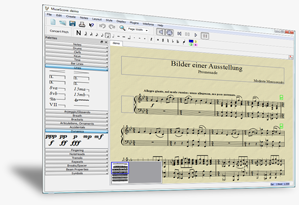
  • WYSIWYG, notes are entered on a "virtual note sheet"
  • Unlimited number of staves
  • Up to four voices per staff
  • Easy and fast note entry with your keyboard, mouse, or MIDI keyboard
  • Integrated sequencer and FluidSynth software synthesizer
  • Import and export of MusicXML and Standard MIDI Files
  • Available for Windows, Mac and Linux
  • Translated in 35 languages
  • GNU GPL licensed

We all run into this problem: You have a part to play but you need to insert a few bars of a line borrowed from another instrument, or you need to transpose the Eb Horn for your F Horn, or you need to move Bass Baritone to Treble Clef Bb, all sorts of little tasks that shouldn't need hundreds of dollars worth of software to do them, and they don't, because MuseScore does all of this and more, for free.

But is MuseScore up to the job? I think so: I was reminded of MuseScore a few days ago reading about the Petrucci Music Library plan to convert the complete Goldberg Variations into a free and open format for download and study; I figure if MuseScore is ready for Bach, it will pretty much do anything our ensemble might require.

And there's more, much more, because MuseScore is "free software", meaning it isn't owned by anyone, it is owned, built, improved and supported directly by the people who use it everyday. That's you and me and thousands of other people; it's like a great software barn-raising, you don't buy free software so much as you join it, you become part of a greater community of musicians, developers and developer-musicians who all work together to solve the problems, help each other, teach each other, address the issues, set the goals and add the features. So the software stays focused and current, and, the best part, you get a say in the matter because you're part of the team; everyone is welcome because that's how it is done, and that fact alone is more than worth the price of admission :)

Friday, 18 February 2011

Hiding YouTube Comments: A Tutorial

Dr. Pisano's YouTube Video on Hiding Comments in Youtube

Many times in the education environment it is not conducive to use YouTube because of what is posted in the comment sections or what appears in the suggestions and playlists.  YouTube does not make this an easy task to do directly from their site.

This tutorial will help you solve that problem by learning how to easily remove the comments by implementing a couple of different solutions.

YouTube is a great resource for showing your music students example performances of the pieces you are working on, for showing authentic performances in particular genres and cultural styles and for illuminating even the most esoteric technique tips on the most obscure instruments, but yes, it can sometimes assume the viewer is an adult mind who will make adult choices on the links offered along the side of the video frame. So what to do?

Here's a techie teaching tip from our friends at MusTech.Net, click on the thumbnail for the video (on YouTube) explaining how to set up the musicroom computer so that you can seamlessly mine the rich resources of that archive without subjecting your students to the very often less than informative comments attached or the sometimes (ahem) curious choices offered in the sidebar as suggestions.

Free music theory worksheets for music teachers (and learners!)

Media_httpmusicworksh_ialhn
Bass Clef drill from musicworksheets.net

on a tip from the musicmattersblog.com, a intro to an emerging website of free printable music theory resources for beginners; key signature drill sheets, reading bass clef (with accidentals!) and keyboard recognition (which is an essential skill for all musicians, even percussionists!). And did I mention it was free?

Friday, 12 November 2010

When You Don???t Feel Like Practicing

You wet the reed, you assemble your instrument, but the inspiration just isn???t there. The fun, the energy, the focus???missing.

But not the motivation. Not, at least, if it???s in the right place. If you???re driven largely by instant gratification, then you might as well hang up your saxophone for the evening and go eat your yogurt. But if your goal is to improve as a musician, then you practice. Whether you feel like it or not is irrelevant. The woodshed still has wood that needs chopping.

Part of becoming a good musician is a matter of character. Will you discipline yourself???because self-discipline is a choice???to push yourself through those inevitable lackluster sessions? If you do, trust me, it???ll pay off over time, not just in your musicianship but also in the kind of person you become. Good musicianship may be an art, but it???s an art that is matured, in tandem with the soul, by discipline.

Some solid practice advice from saxophonist and storm chaser Bob Hartig. It's true, just about everyone at some time feels there's no gain to be had, but practice is also about conditioning the body and the mind-body connections, and those gains happen just through the doing. Besides, sometimes all you really needed to cheer you into an inspired mood is a little bit of making your own music!

Friday, 24 September 2010

Culture Days in & around Owen Sound (Sept 24-26)

Music at the Market


Culture Days is a collaborative pan-Canadian volunteer movement to raise the awareness, accessibility, participation and engagement of all Canadians in the arts and cultural life of their communities.

One weekend. Thousands of free cultural things for you to do, make, paint, sculpt, act, sing, dance, write, and learn. Discover the world of artists, historians, architects, curators and designers in your community. Inspire the creator in you!


“We believe that the key to understanding and appreciating art and heritage is through direct contact with everyone who creates, invents, communicates, develops, teaches and disseminates all forms of artistic expression that underpins a society’s culture.”

CultureDays events: Within 75 km of: Owen Sound, ON

Culture Days is a collaborative movement that relies on your participation. Everyone has a role they can play, as a citizen, as a business person, as a cultural professional, on behalf of an organization, or in any other way you can imagine. You can be among the first to join this exciting new cross-country network by first subscribing to Culture Days e-bulletins, and inviting your friends, family and colleagues to join the movement.
see more national listings at culturedays.ca


Sunday, 5 September 2010

Kodaira Dairoku Junior High School Band

From the Japan Wind Orchestra and Ensemble Competition, our twitter-pal @windband tips us to this video of a pretty impressive bit of school bandwork.

Thursday, 2 September 2010

Claude Gordon???s ???The Seven Basic Items???

Media_httpbrassmusici_hifyc

Why did so many people come from so far away to study with Claude Gordon? What made him unique? Why do so many people owe their careers to this man’s teaching?

The following is an overview of “The Seven Basic Items” with a few brief comments on their implications. Each item is intended to work together in harmony with all the other items. If one item isn’t working correctly there will come a day when the player will struggle.

These exact items are also found in Herbert L. Clarke’s Setting Up Drills, which shows how Claude approached things exactly like Clarke did. He studied with Clarke for ten years. Gordon’s Brass Playing Is No Harder Than Deep Breathing has been misunderstood by some as focusing only on breathing. The point is that once everything is working correctly, playing is as simple as taking a big breath, which anyone can do